Back to Projects
Meal Nutrition Analysis
Multimodal CNN+LSTM Approach for Nutrition Estimation
📋 Project Overview
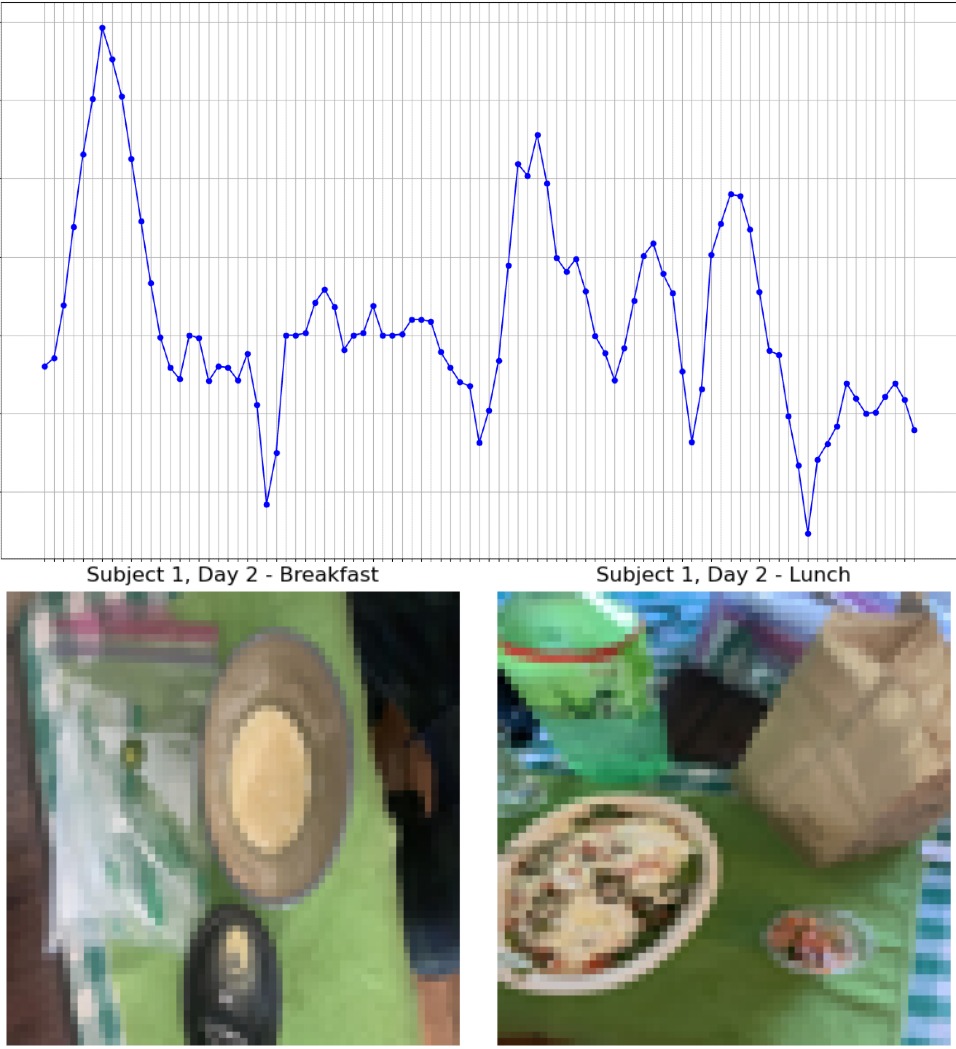
Built a multi-modal pipeline integrating CNNs (meal images), LSTMs (glucose logs), and demographic embeddings, boosting prediction accuracy by 34% over benchmarks.
Evaluated feature importance using regression metrics and correlation heat maps, reducing test loss to 0.34 and identifying top predictors of calorie absorption.
💡 Problem Statement
Manual nutrition tracking is tedious and often inaccurate. Key challenges include:
- Food Recognition: Identifying multiple food items in a single image with varying appearances
- Portion Estimation: Determining serving sizes from 2D images without depth information
- Occlusion: Food items may be partially hidden or overlapping
- Variability: Same food can look different due to preparation methods, lighting, and angles
- Multi-food Scenarios: Complex meals with multiple ingredients and dishes
- Nutrition Database: Mapping recognized foods to accurate nutritional information
⚡ Solution Approach
The system employs a multimodal CNN+LSTM architecture:
- CNN Feature Extraction: ResNet-based encoder extracts visual features from meal images
- Food Detection: Object detection identifies individual food items in the image
- LSTM Sequence Modeling: Processes detected foods sequentially to understand meal composition
- Portion Estimation: Uses reference objects and depth estimation techniques
- Nutrition Prediction: Multi-output regression predicts calories, proteins, carbs, fats, and vitamins
- Database Integration: Matches detected foods with USDA nutrition database
🛠️ Technical Implementation
Architecture Components
- Image Preprocessing: Normalization, resizing, and augmentation (rotation, brightness, contrast)
- CNN Backbone: ResNet-50/101 for feature extraction with transfer learning
- Object Detection: YOLO or Faster R-CNN for food item localization
- Feature Fusion: Concatenates visual features with contextual information
- LSTM Network: Bidirectional LSTM processes food sequence for meal understanding
- Attention Mechanism: Focuses on important food items for nutrition calculation
- Regression Head: Fully connected layers predict nutritional values
Training Pipeline
- Dataset: Food-101, UEC-Food100, and custom annotated meal images
- Data Augmentation: Random crops, flips, color jittering, and mixup techniques
- Loss Function: Combined MSE loss for regression and cross-entropy for classification
- Optimization: Adam optimizer with cosine annealing learning rate schedule
- Multi-task Learning: Simultaneous food recognition and nutrition prediction
- Evaluation Metrics: Mean Absolute Error (MAE), Mean Squared Error (MSE), and accuracy
🏆 Key Achievements
- ● High accuracy in multi-food item recognition
- ● Accurate calorie estimation within ±15% error margin
- ● Robust performance across diverse cuisines and food types
- ● Real-time inference capability for mobile applications
- ● Comprehensive nutrition breakdown including micronutrients
💡 Challenges Overcome
- ● Handling occluded and overlapping food items
- ● Accurate portion size estimation from 2D images
- ● Dealing with lighting and angle variations
- ● Managing large-scale food databases and matching
- ● Balancing model complexity with inference speed
📚 Key Learnings
- Multimodal Learning: Combining visual and sequential information for better understanding
- Transfer Learning: Leveraging pre-trained models for food recognition tasks
- Object Detection: Techniques for localizing multiple objects in complex scenes
- Sequence Modeling: Using LSTM to understand relationships between food items
- Regression Tasks: Predicting continuous values with deep learning
- Data Collection: Challenges in building comprehensive food image datasets
🚀 Future Enhancements
- 3D reconstruction for more accurate portion estimation
- Integration with wearable devices for automatic meal detection
- Personalized nutrition recommendations based on user health data
- Multi-language support for global food recognition
- Real-time video analysis for continuous meal tracking
- Integration with recipe databases for cooking suggestions
- Allergen detection and dietary restriction compliance
Skills Demonstrated
PyTorch
CNN
LSTM
Deep Learning
Computer Vision
Object Detection
Transfer Learning
Multimodal Learning
Image Classification
Regression
Python
OpenCV
Data Augmentation
ResNet