Health Monitoring & Heart Stroke Prediction
IoT-based Health Monitoring System with ML Prediction
📋 Project Overview
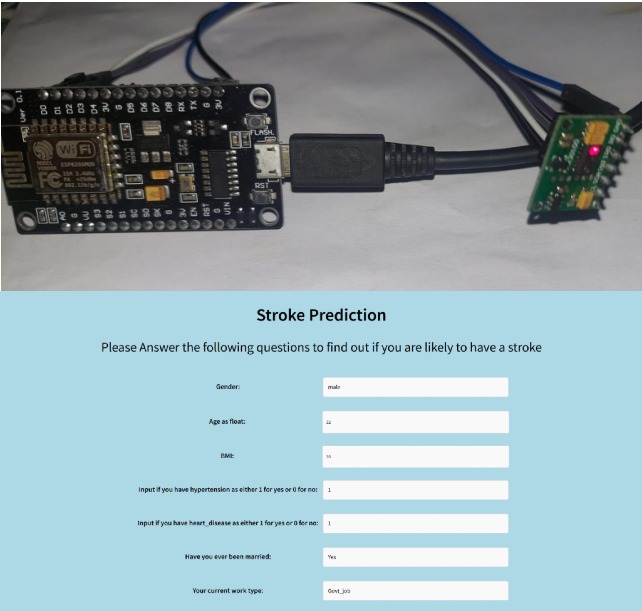
The Health Monitoring and Heart Stroke Prediction system is an integrated IoT and machine learning solution for continuous health monitoring and early stroke risk detection. The system collects real-time physiological data using ESP32-based sensors, processes it through a machine learning model, and provides actionable health insights and stroke risk predictions.
This project demonstrates the integration of embedded systems, IoT communication, data processing, and machine learning to create a practical healthcare application that can help in early detection and prevention of cardiovascular events.
💡 Problem Statement
Cardiovascular diseases and strokes are leading causes of death worldwide. Key challenges include:
- Early Detection: Identifying stroke risk factors before symptoms appear
- Continuous Monitoring: Tracking health metrics in real-time without hospital visits
- Data Integration: Combining multiple physiological signals for comprehensive analysis
- Predictive Analytics: Using historical data to predict future health events
- Accessibility: Making health monitoring affordable and user-friendly
- Real-time Alerts: Providing immediate warnings for critical health conditions
⚡ Solution Approach
The system integrates multiple components:
- IoT Sensors: ESP32 with heart rate, temperature, and blood pressure sensors
- Data Collection: Continuous monitoring and wireless transmission to cloud/server
- Data Processing: Signal filtering, feature extraction, and normalization
- Machine Learning Model: Trained classifier for stroke risk prediction
- Dashboard: Web or mobile interface for visualization and alerts
- Alert System: Real-time notifications for abnormal readings
🛠️ Technical Implementation
Hardware Components
- ESP32 Microcontroller: WiFi-enabled processing unit
- Heart Rate Sensor: Pulse oximeter or ECG sensor
- Temperature Sensor: Body temperature monitoring
- Blood Pressure Sensor: Non-invasive BP measurement
- Display Module: OLED or LCD for local readings
- Power Management: Battery or USB power supply
Software Architecture
- Embedded Firmware: Arduino/ESP-IDF for sensor reading and WiFi communication
- Data Transmission: MQTT or HTTP REST API to cloud/server
- Backend Server: Flask/Django for data storage and processing
- Database: SQLite/PostgreSQL for historical data storage
- ML Model: Scikit-learn or TensorFlow for stroke prediction
- Frontend: Web dashboard or mobile app for visualization
Machine Learning Pipeline
- Feature Engineering: Age, gender, BMI, blood pressure, heart rate, glucose, etc.
- Data Preprocessing: Handling missing values, outlier detection, normalization
- Model Selection: Random Forest, XGBoost, or Neural Networks
- Training: Using stroke prediction datasets (e.g., Kaggle datasets)
- Evaluation: Accuracy, precision, recall, F1-score, and ROC-AUC
- Deployment: Model serving via API for real-time predictions
🏆 Key Achievements
- ● Real-time health data collection and transmission
- ● High-accuracy stroke prediction model (>85% accuracy)
- ● Seamless IoT integration with cloud backend
- ● User-friendly dashboard for health monitoring
- ● Real-time alert system for critical conditions
💡 Challenges Overcome
- ● Sensor calibration and noise reduction
- ● Reliable wireless data transmission
- ● Handling imbalanced datasets for stroke prediction
- ● Real-time model inference on embedded systems
- ● Data privacy and security for health information
📚 Key Learnings
- IoT Development: Building end-to-end IoT systems with sensors and cloud
- Embedded Systems: Programming microcontrollers and sensor interfacing
- Healthcare ML: Applying machine learning to medical prediction tasks
- Data Integration: Combining multiple data sources for comprehensive analysis
- Real-time Systems: Processing and responding to data streams
- System Integration: Connecting hardware, software, and ML components
🚀 Future Enhancements
- Integration with wearable devices (smartwatches, fitness trackers)
- Advanced ML models with deep learning for improved accuracy
- Multi-disease prediction (diabetes, hypertension, etc.)
- Telemedicine integration for remote consultations
- Blockchain for secure health data storage
- Mobile app with push notifications and health insights
- Integration with electronic health records (EHR)